How to choose the universe your screen runs on
Ask an investor what's in their screen and you'll hear the rules: an F-Score of 8 or better, an earnings yield in the top decile, free cash flow above zero. Ask what the screen ran against and you'll often get a pause. That second thing is the universe: the set of companies your rules are allowed to consider, fixed before the first rule runs. It does as much selection work as the rules themselves, and in most tools it's the part nobody reads.
Choosing a universe deliberately comes down to four questions. Where does a company have to be listed? How big does it have to be for you to trade it sanely? Which sectors does your arithmetic not apply to? And what happens to names your data can't fully describe? Answer those on purpose and every screen you build afterward inherits the care. Leave them to defaults and you've handed a chunk of your strategy to whoever wrote the defaults.
Every screen has a universe, even if you never chose it
There is no such thing as screening "the whole market." A screen that claims to is really running against whatever its data vendor covers, and that coverage is itself a set of decisions about which exchanges count and what kinds of filers the vendor can describe. Point a naive screen at "all US stocks" and you've invited in over-the-counter names with irregular or nonexistent filings, ADRs (US-listed wrappers around foreign shares, reporting on foreign schedules and foreign accounting standards), blank-check shells with no operations to measure, and multiple share classes of the same underlying business. Your carefully designed criteria will then produce carefully ranked nonsense at the edges, because the inputs at the edges don't mean what the criteria assume.
The classic published screens understood this and said so. Joel Greenblatt's magic formula doesn't rank every listed stock: it excludes financials and utilities outright and starts from a $50 million market cap floor, with the suggestion that investors raise that floor to match their own liquidity needs. Joseph Piotroski built his F-Score for cheap value stocks specifically, and the signal worked best among small and medium-sized value companies, a fact about the universe as much as about the score. When the original authors publish a screen, the universe definition is part of the method. When a screening tool reimplements one, the universe is usually the first thing to change, and nobody mentions it.
What a sector exclusion actually says
A sector exclusion done honestly is a statement of scope: my arithmetic does not mean anything for this kind of business. That's different from having a view on the sector.
Banks are the cleanest example. A net-net screen prices a company against its current assets minus all liabilities, which is a sensible liquidation lens for a manufacturer holding inventory and receivables. A bank's balance sheet is loans funded by deposits; "current assets" under that lens describes nothing about what the equity would fetch. The same goes for enterprise-value math: EV treats debt as part of the price of the business, but for a bank, debt is the business. Utilities carry regulated returns and structurally heavy debt that make cross-sector comparisons of leverage and returns on capital misleading. Property companies are dominated by depreciation charges that do strange things to reported earnings. None of these sectors is uninvestable. They just need different arithmetic, which means a different thesis.
Quantery's bundled templates make these scope calls in the open. The Piotroski F-Score template excludes Financial Services and Real Estate because bank leverage and REIT balance sheets don't mean what the score's signals assume. The Greenblatt Magic Formula template follows Greenblatt's own exclusions and drops Utilities as well, since its return-on-capital math breaks where capital is regulated or mostly financial. The universe block sits at the top of the thesis in the visual builder, above the parameters and features, and it's editable like everything else.
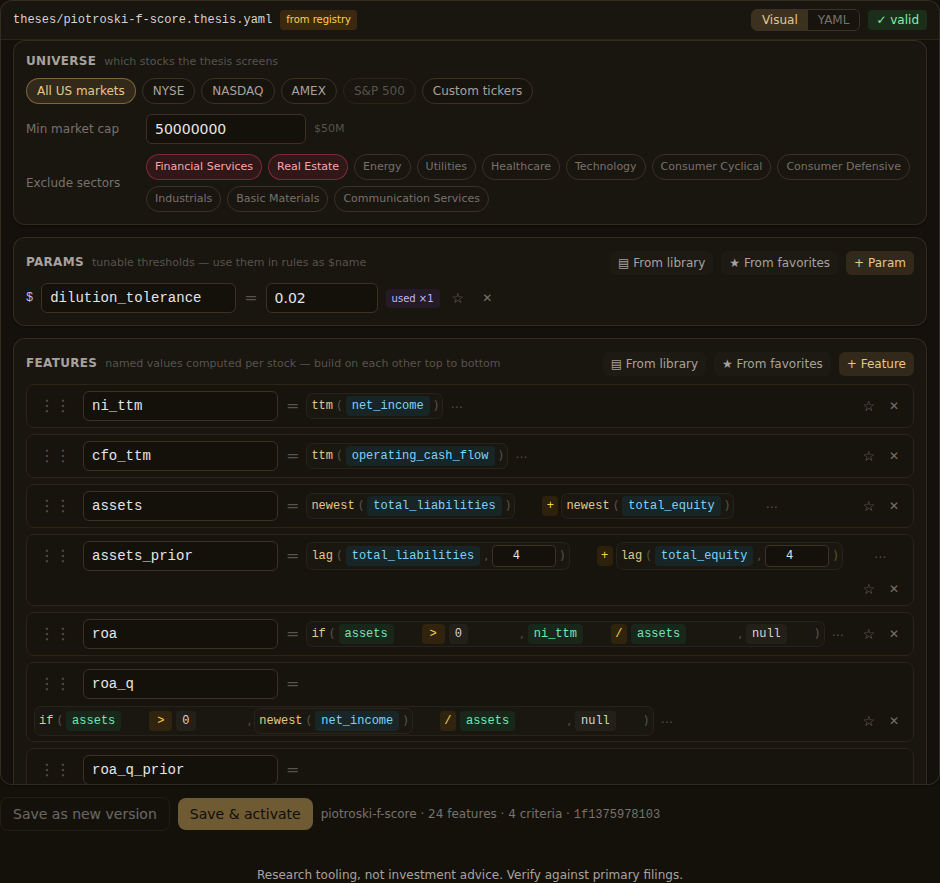
There's a dishonest version of the same move, and it's worth naming. Excluding a sector because it hurt your backtest is tuning, the same overfitting trap as a threshold tweaked until the results look good. The test is whether you can state the reason for the exclusion without mentioning returns. "Current assets are meaningless for banks" passes. "Energy dragged down the 2014 cohort" does not, and if that's the real reason, what you've learned belongs in how you read results, not in the universe.
The market-cap floor is really about you
Every other universe filter describes companies. The market-cap floor mostly describes the person running the screen: how much money you're deploying and how much slippage you can stomach. Below some size, bid-ask spreads widen and your own buying starts to move the price against you. A paper edge in names you can't accumulate without becoming the volume isn't an edge you can collect, and since backtests exclude those costs by construction, the floor is where you build the honesty in.
The uncomfortable part is that classic value screens keep finding their best material in exactly those small names. Piotroski's results, again, concentrated in small and mid-sized value stocks. Graham-style net-nets are almost definitionally tiny: the bundled Graham Net-Net template sets its floor at $25M, because a large floor would empty the screen entirely (the scarcity of live net-nets is its own story). Meanwhile the Buffett Quality Value template sets its floor at $2 billion, because that thesis is about durable franchises rather than statistical cheapness. Same engine, same field name, an eighty-fold difference in the floor. Both are right, for their theses.
That makes the floor a genuinely useful experiment dial. Run your screen at your honest floor, then raise it and run again. Scans in Quantery are unlimited, so this costs you nothing but minutes. If your idea survives at $500M, you've learned it isn't purely a small-cap artifact. If every survivor lives just above whatever floor you set, you've learned the idea concentrates precisely where trading it is most expensive, which is a finding about implementability that no return number would have told you.
Missing data shrinks your universe without telling you
Here's the filter almost nobody writes down: data coverage. A screen that needs five years of filing history to compute year-over-year signals can't evaluate a company that IPO'd two years ago. A feature built on capex can't be computed for a filer that reports it in an unusual place. Whatever your tool does with those names, drop them or score the missing signal as zero, your effective universe shrank, and the shrinkage never appears in the rules you wrote.
The discipline is to make the dropout visible instead of pretending it isn't happening. Quantery theses declare their data requirements: the bundled templates list which raw fields must be present, treat features with missing inputs as null rather than fabricating a zero, and flag names whose filing history is too short for the year-over-year signals instead of scoring them as if the history existed. When you read a survivors list, the honest question isn't only "who passed?" but "who was never really evaluated?" A screen of the US market that could compute its features for only a fraction of listed names is a screen of that fraction. That's fine, as long as you know it.
The universe is part of what a backtest replays
One more property that matters as soon as you test anything: a universe is a definition, and a definition has a different membership on every date. "NYSE-listed, above $50M, not a financial" picks out a different set of companies in 2016 than today, including plenty that have since delisted or been acquired. An honest backtest re-applies your universe definition at each simulated date, dead names included. The infamous shortcut, running history against today's index membership, is survivorship bias wearing a universe costume: the definition "companies in the S&P 500 right now" smuggles years of survival into your starting list.
This is why the universe block belongs inside the thesis rather than in some settings page. It versions with the thesis, it replays with the backtest, and when you change it, you can see exactly what the change did.
Write the choices down, then shake them
Stated plainly, a deliberate universe is a handful of lines. The shape below is illustrative (the bundled templates are the reference for exact fields), and every line carries its reason:
# The guest list, with reasons - illustrative
universe:
  exchanges: [NYSE, NASDAQ, AMEX]     # listed filers only, no OTC
  min_market_cap: 100000000           # tradability at my size, not taste
  exclude_sectors: [Financial Services, Real Estate]
                                      # my ratios don't apply to banks/REITs

features:
  dollar_volume: avg_volume * price

gate:
  - dollar_volume > 1000000           # I can get in and out without being the volume
Then treat those lines the way you'd treat any parameter: perturb them and watch what happens. Move the floor and re-run. Add a sector back and read the survivors it admits, one by one, asking whether your features mean anything for those businesses. If a conclusion flips because the floor moved from $100M to $200M, the conclusion was about the floor, and better to learn that from two scans today than from a position later.
The bundled templates disagree with each other about the universe on purpose, and that disagreement is the lesson. A universe is only right relative to a claim. So when you adapt a template, before touching a single threshold, read its universe block and ask whether the guest list fits your claim, at your size. The rules are yours in this product, and the universe is the first rule.
Research tooling, not investment advice. Nothing here is a recommendation to buy, sell, or hold any security. Screens, scores, and backtests are informational only; backtested results are hypothetical, exclude costs such as commissions and slippage, and do not guarantee future results. Verify against primary filings and make your own decisions.
Want to try this on your own rules? Quantery is free for 14 days: the full app, no card required.
← All articles