How to read a balance sheet: assets, liabilities, equity
A balance sheet is a photograph of one day. It lists what a company owns, what it owes, and what's left over for the owners, and it obeys one equation that never breaks:
assets = liabilities + equityEverything the company controls sits on the left. Every claim against it sits on the right, creditors ahead of owners. Equity is whatever remains once the creditors are satisfied, which is why accountants call it the residual and everyone else calls it book value.
The equation holds by construction. Double-entry bookkeeping makes every entry land twice, so the two sides close whether the business is thriving or on fire. That's the first thing to know about a balance sheet: it can't tell you it's wrong. It can tell you how a company is funded and how much cushion sits between its assets and its creditors. It can't tell you what those assets would fetch today, and for some businesses it barely tells you anything. This post walks a real filing, covers the three ways book value misleads people, and shows how a thesis reads the balance sheet without getting fooled.
This is the third article in a series building up the vocabulary our screens use. The first mapped how the three financial statements fit together. The second covered which numbers a thesis can trust: filed and trailing, over estimated and forward.
The equation, on a filing you can check
McDonald's newest quarter ended 30 June 2026 and reached the SEC on 7 August. Open the 10-Q itself and find the condensed balance sheet. Two totals are printed on it:
- Total assets: $59.920 billion
- Total shareholders' equity (deficit): negative $1.023 billion
That "(deficit)" is the filing's own label, and we'll get to it. First, look for total liabilities. It isn't there. McDonald's balance sheet, like plenty of others, never prints that subtotal: the bottom line reads "total liabilities and shareholders' equity (deficit)", $59.920 billion, equal to total assets by construction. The equation is how you recover the missing number. Move equity across and total liabilities come to $60.943 billion, which is exactly what our data lake stores for that filing. The equation closes with a negative number sitting inside it, and nothing has gone wrong. On a carrying-value basis McDonald's owes more than it owns, and the arithmetic reports that faithfully. Checking both printed lines against the filing takes under a minute.
That's the whole trick of the balance sheet. It always balances, so balancing is never the news. The news is in the proportions.
What book value means, and what tangible book value means
Book value and total equity are the same number wearing different hats. Book value per share divides it by the share count, which gives roughly negative $1.45 against the 707.6 million shares outstanding on that filing's cover page.
Equity accumulates from two sources over the entire life of a company: capital raised by issuing stock, and profit earned and kept. The wire that does the keeping is the first joint between the statements, where net income lands in retained earnings and dividends and buybacks subtract from it. So equity isn't an opinion about what a business is worth. It's a running total of money put in and money left in, going back to the incorporation papers.
Strip out goodwill (the premium a past acquirer paid above a target's identifiable net assets) and other intangibles, and you get tangible book value, the version deep-value readers prefer because it counts only assets with an independent existence. That same McDonald's filing carries $3.347 billion of goodwill, so tangible book value is negative $4.370 billion, about negative $6.18 a share. Our lake stores both, because the gap between them is often the interesting part.
Why a profitable company can show negative equity
McDonald's isn't a distressed company. Sum its last four quarters, which takes the 10-Q's six-month figures plus the 2025 annual report's full year minus the overlap, and trailing twelve month net income comes to $8.787 billion on $27.702 billion of revenue, a net margin near 31.7 percent.
So how does a business like that end up under water on book equity? By returning more cash to shareholders than it retains, for long enough. That same June 2026 filing shows $1.317 billion of dividends paid and $856 million spent buying back stock in the quarter, against $2.362 billion of net income. Keep that up for years, repurchasing shares at prices far above book value, and the accumulated ledger goes negative.
A buyback takes cash off the asset side and takes the same amount out of equity. The restaurants are identical the next morning. Book value fell because the company handed cash to its owners, not because the business got worse.
So negative equity is a statement about distribution history. On its own it says the owners have taken out more than they left in, and whether that was wise depends on what the shares cost and what the business earns. The balance sheet answers neither question.
Why Buffett stopped reporting book value per share
For nearly three decades the opening paragraph of Berkshire Hathaway's annual letter featured the percentage change in its per-share book value. In the 2018 letter Buffett retired it, writing that the annual change in Berkshire's book value "is a metric that has lost the relevance it once had," and giving three circumstances for the change.
First, Berkshire "has gradually morphed from a company whose assets are concentrated in marketable stocks into one whose major value resides in operating businesses." Second, "while our equity holdings are valued at market prices, accounting rules require our collection of operating companies to be included in book value at an amount far below their current value." Third, buybacks: at prices above book value but below his own estimate of intrinsic value, "each transaction makes per-share intrinsic value go up, while per-share book value goes down."
That third point is the McDonald's mechanism, described by someone doing it on purpose. The second point is the deeper problem, and it generalizes well beyond Berkshire.
What book value leaves out
Three gaps.
Historical cost. Assets are carried at what was paid for them, less depreciation. Land bought in 1970 sits on the books at 1970 prices no matter what happened to the neighborhood since. For a company holding appreciated real estate, book value understates by an amount you can't read off the statement at all.
Internally generated intangibles never show up. Research spending and brand building are expensed as they occur, so the asset they create has no line anywhere. A software company's engineering payroll is a cost, and the product it built is invisible. That's a large part of why price-to-book makes asset-light businesses look permanently expensive.
Goodwill is the opposite failure. When one company buys another, the premium above identifiable net assets gets booked as goodwill. The balance sheet then records what a past acquirer paid for a business instead of anything about the business itself. Overpay, and the number sits there until an impairment charge admits it years later.
So where does book value still earn its keep? On asset-heavy balance sheets whose assets sit close to cash: inventory, receivables, marketable securities. That's the entire premise of pricing a business at its net current asset value, where the assets are liquid enough that carrying value makes a defensible floor. The further a company drifts from that shape, the less the residual means.
How a thesis reads the balance sheet
Two habits from the bundled templates, both about refusing to compute a number that would look fine and mean nothing.
The Buffett Quality Value template, the same one your first scan walks through running, reads equity as a level, then guards every use of it:
features:
  equity: latest(total_equity)
  ni_ttm: ttm(net_income)
  roe:    if(equity > 0, ni_ttm / equity, null)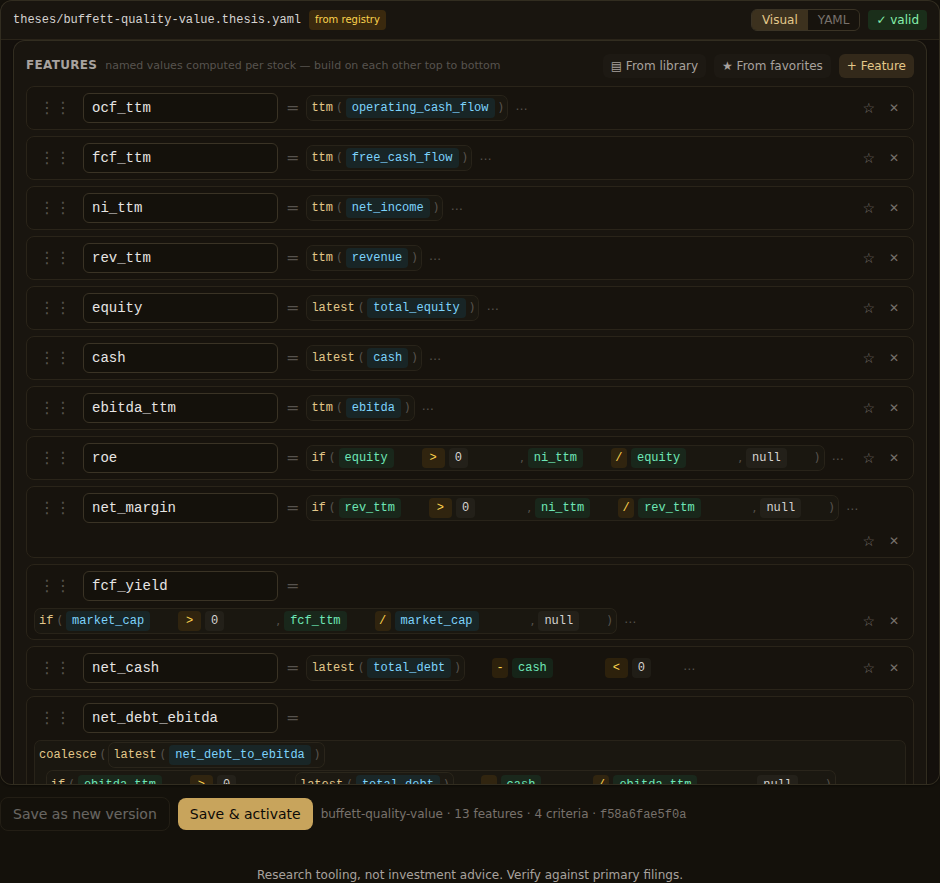
Drop McDonald's into that and watch the guard earn its place. Trailing net income is positive $8.787 billion and equity is negative $1.023 billion, so the raw division returns a return on equity of about negative 859 percent. Sort a column on that and one of the most profitable businesses in the country lands at the bottom of your list for a reason that has nothing to do with its profitability. The equity > 0 test returns null instead.
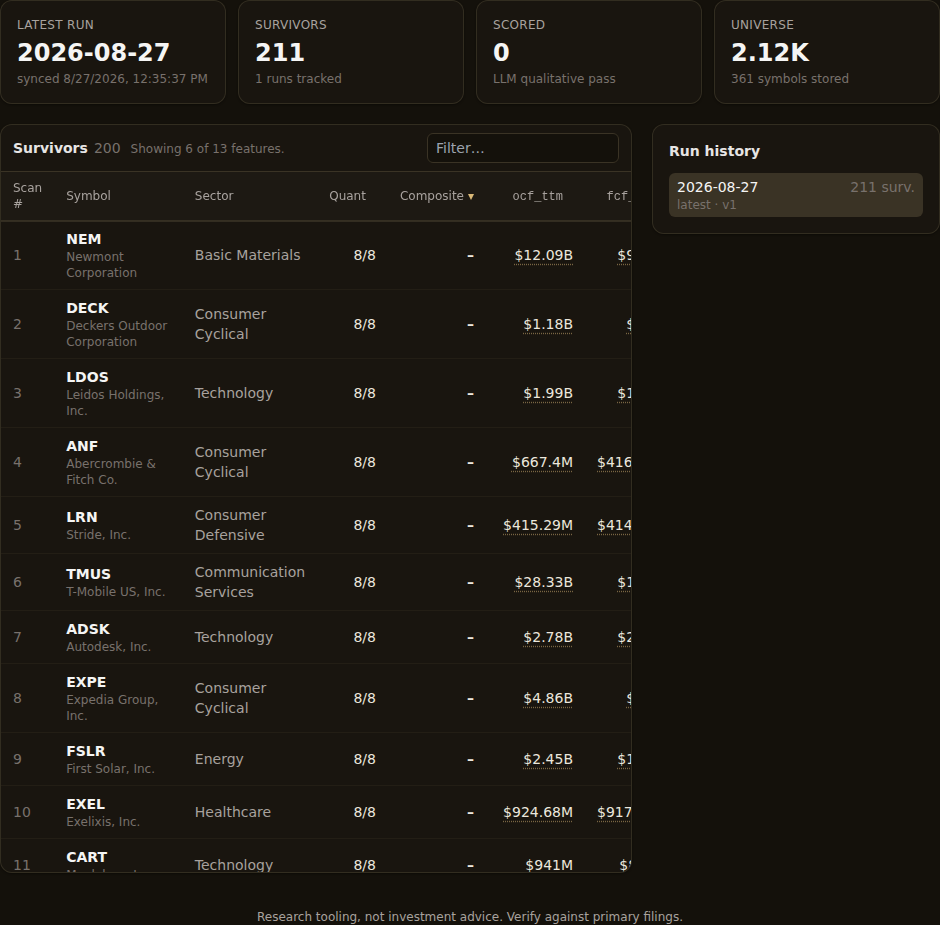
We ran that template while writing this article, on 27 August 2026. 211 names cleared its strict gate, and McDonald's wasn't among them: with roe null, the quality criterion scored 0 and raised the flag no_roe, which under a strict gate is disqualifying on its own. The balance sheet cost it a second time on leverage. The June filing lists $39.9 billion of long-term debt against $822 million of cash, and net debt at that scale sits well past the template's leverage ceiling of twice EBITDA, so safety scored 0 too. Marked unmeasurable by this lens, which is the truthful answer for a company whose denominator went negative.
The second habit shows up in the Piotroski F-Score template, which needs total assets and builds them from the equation:
features:
  assets: newest(total_liabilities) + newest(total_equity)
Both terms come from the same filing, deliberately. The three-statements article covers why crossing periods there fabricates a balance sheet that never existed. The short version: a strict same-filing read returns a null when a term is missing, and a loose one returns a plausible number that's wrong.
Put the habits together and a balance-sheet rule of your own looks like this. The shape is illustrative and the bundled templates are the reference for exact fields:
# "Read the balance sheet, and refuse to guess" - illustrative
params:
  cushion_min: 0.35            # equity as a share of the balance sheet

features:
  equity:   newest(total_equity)
  assets:   newest(total_liabilities) + newest(total_equity)
  gw:       newest(goodwill)
  tangible: equity - gw
  cushion:  if(assets > 0, equity / assets, null)
  ni_ttm:   ttm(net_income)
  roe:      if(equity > 0, ni_ttm / equity, null)

criteria:
  funded_conservatively:
    rules:
      - { when: "is_null(cushion)", score: 0, flag: no_balance_sheet }
      - { when: "cushion >= $cushion_min", score: 2 }
      - { when: "cushion > 0", score: 1 }
      - { else: 0 }
  book_is_real:
    rules:
      - { when: "is_null(tangible)", score: 0, flag: no_tangible_book }
      - { when: "tangible > 0", score: 1 }
      - { else: 0 }

gate:
  - assets > 0                 # no balance sheet, no score
cushion is equity over assets: the slice of the balance sheet belonging to owners once every creditor is counted. tangible strips the goodwill back out, so a company that bought its book value gets no credit for it. Every branch has a null case, because a missing line item should cost a name its points.
What it does and doesn't buy you
A low price-to-book ratio doesn't make a stock cheap. The balance sheet is one day's photograph of carrying values, assembled under rules that ignore appreciation, ignore brands, and remember acquisition prices forever. The market is busy pricing the years that come after the photograph.
What it does hand you is capital structure in plain arithmetic: who holds a claim, how much cushion the owners have under them, and whether tangible assets sit beneath the residual. Those are checkable facts, and each either survives a look at the filing or it doesn't. That is the property worth building a rule on. The DSL reference has the full field vocabulary if you want to turn the rule above into something of your own.
Next in the series: working capital and the current ratio, and why "current" stops meaning the same thing the moment you leave the industrials.
Research tooling, not investment advice. Nothing here is a recommendation to buy, sell, or hold any security. Screens, scores, and backtests are informational only; backtested results are hypothetical, exclude costs such as commissions and slippage, and do not guarantee future results. Verify against primary filings and make your own decisions.
Want to try this on your own rules? Quantery is free for 14 days: the full app, no card required.
← All articles