How to read near-misses in a stock screen
Read a near-miss by identifying why it failed the thesis gate, then tracing that failure through the gate type, criterion scores, data quality, and source inputs. In Quantery, a near-miss is a retained scan result that didn't pass the gate. The label doesn't endorse the company, and it doesn't mean the result sat barely below a cutoff.
Start with the gate definition. A score gate can reject a result even when every criterion earned some credit, while a strict gate can reject it because one criterion earned no points. Missing or stale required data creates another kind of failure regardless of the score. Those cases call for different diagnoses, so the total alone won't tell you enough.
A near-miss tells you that the gate failed
A survivor has passed the thesis gate. A near-miss has failed it but remains available for inspection. Quantery hides those failed rows at first so the survivors view stays useful. Turn on Near-misses to place them beside the survivors, where the near badge marks their status.
That status is precise but narrow. It says the row didn't satisfy the final admission rule. It doesn't say whether the cause was a weak total, a zero-scoring criterion, or unusable evidence. A result far below a score threshold and one just under it can carry the same badge.
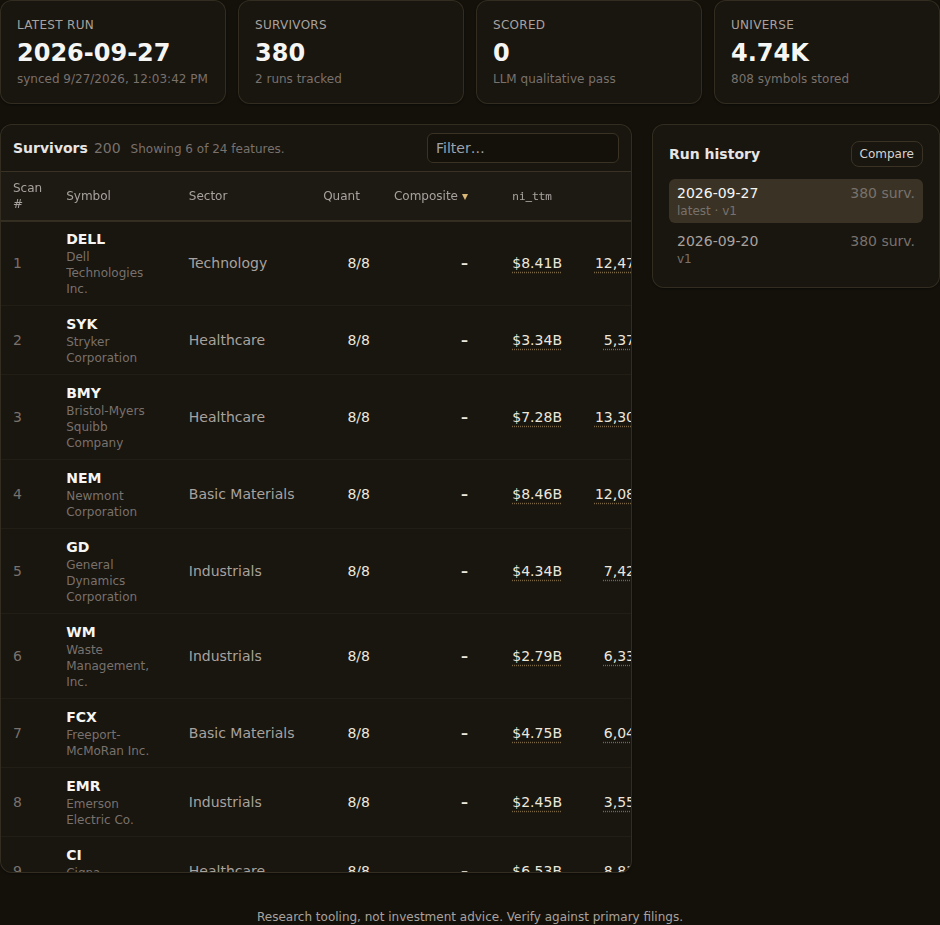
Treat the view as a diagnostic queue. Pick a row, identify the gate it faced, and ask which of these questions applies:
- Did the total fall short of a score threshold?
- Did a strict gate find a criterion with no points?
- Did data quality prevent the row from being eligible to pass?
Don't combine those answers into a vague judgment that the company was "almost good enough." The gate evaluates the rules you wrote. It doesn't estimate the quality of the business outside those rules.
The gate type defines what close means
A score gate adds the criterion scores and compares the total with a minimum. Evidence can compensate for other evidence. A result can receive some credit from every criterion and still finish below the required total. In that case, no individual criterion has failed in the all-or-nothing sense. The sum is too low.
A strict gate asks a different question: did every criterion earn at least some credit? One criterion with no points blocks the row even when the other criteria score well. If you need a fuller comparison, strict gates and score gates solve different thesis-design problems.
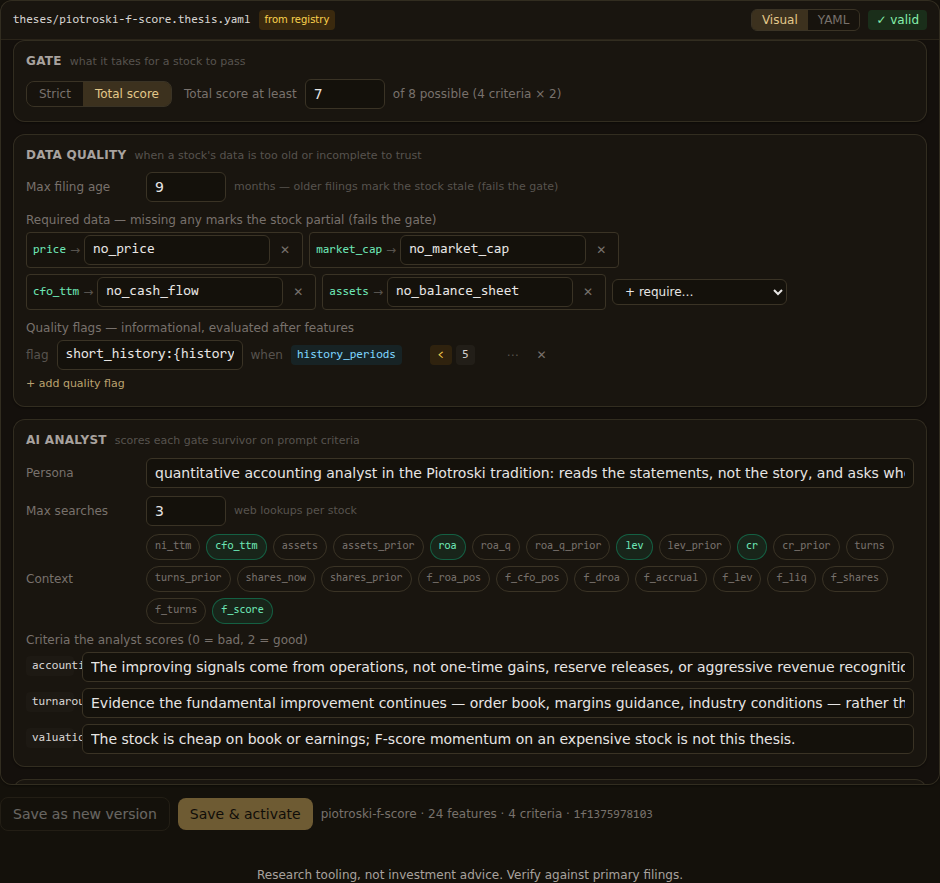
This distinction matters when you read missed_criteria. The field lists only criteria whose score equals zero. It isn't a complete explanation of every failed gate.
Under a strict gate, a listed criterion often points straight to the blocker. Under a score gate, an empty list can accompany a failed row because each criterion earned partial credit while the total remained below the minimum. An empty list means that no criterion scored zero. It means nothing more.
So read the total and the per-criterion scores together. If the thesis uses a score gate, compare the total with the gate threshold and inspect where partial credit accumulated. If it uses a strict gate, look first for a criterion with no points, then inspect the rule that produced that score.
Missing evidence is a separate failure class
A score describes how the available evidence matched the thesis. Data quality asks whether the evidence was fit to evaluate at all. Quantery allows only results with acceptable data quality to pass a gate. A required input that is null, or a newest filing that has become stale under the thesis rules, can block the result regardless of its score.
That isn't the same diagnosis as weak fundamentals. Suppose a cash-flow criterion earns no points because the filed value is present and fails the rule. The thesis evaluated evidence and rejected it. If the required cash-flow input is absent, the thesis lacks the evidence needed to make that comparison. Loosening the criterion threshold won't repair the missing input.
Read data-quality flags before editing any economic rule. Check which field was required, whether the latest filing is stale, and whether the thesis's universe or exclusions made the row ineligible. If coverage is the problem, use the data-coverage preflight to separate an unavailable history from a weak signal.
Null handling deserves the same care. A comparison against a null value doesn't become evidence for the fallback case. Well-formed criteria give missing inputs an explicit path, usually a zero score plus a flag, while required fields can stop the row at the quality layer. The distinction belongs in the thesis design because it changes what a near-miss means.
Read the matched rule before changing a threshold
Once you've classified the failure, follow the result back through the rule that produced it. The useful sequence is short:
- Confirm the gate mode and its threshold, if it has one.
- Read the total and each criterion's score.
- Open the matched rule for the criterion you care about.
- Trace its feature value to the underlying filing inputs and dates.
- Check the data-quality flags and any nulls.
A criterion can contain several ordered rules, and the first matching rule wins. Reading only the criterion label skips the branch that actually fired. A profitability criterion might award full credit above one boundary, partial credit above another, and no points otherwise. The matched rule tells you which claim the scan made.
Then inspect provenance. A feature such as trailing cash flow may draw on several filed periods. A year-over-year change needs the comparable fiscal period instead of whichever row happens to precede it. The result-audit workflow shows how to keep the value recorded with a scan separate from a later live re-evaluation and how to trace a feature back to its filings.
That separation prevents a common false alarm. A live value can differ after a new filing arrives even though the original scan was correct for the information available at its run time. Diagnose the recorded result with the recorded inputs. Use the live calculation to understand drift without rewriting history.
Repeated near-misses test the thesis design
One failed row is an example. A cluster is a pattern worth testing.
If many complete rows collect just under a score threshold, the threshold or criterion weights may be doing more work than expected. If many rows receive no points from the same criterion, its boundary may be brittle, its input may have uneven coverage, or the evidence may be genuinely rare. If failures share a data-quality flag, changing the score gate is aimed at the wrong layer.
Look at the distribution before touching the rule. Do values bunch near a boundary, or sit far away from it? Does the pattern appear across sectors, or come from a business model for which the metric has a different meaning? Do failed rows share a missing field? These questions turn a list of exceptions into a test of the thesis.
Don't loosen a rule because one familiar company appears among the near-misses. That works backward from a desired inclusion. Write down the general reason the rule may be wrong, and state what pattern should change if your explanation is right. The revised rule should apply to every company exposed to it.
Change one rule at a time, save the revision as a new thesis version, and rerun against the same intended universe. Compare which rows entered, which left, and which stayed near the boundary. If several criteria move together, you won't know which change caused the difference. The same discipline applies when you test whether a stock score carries useful ordering.
A material rule change deserves a backtest as well. The rerun shows how today's classification changed. A point-in-time backtest asks whether the revised rule behaved consistently across earlier decision dates. It can expose a threshold fitted to the current cross-section, though it can't rescue a weak economic premise.
Use near-misses to make the next test sharper
The useful output of a near-miss review is a diagnosis you can challenge. Record the gate type, the exact matched rule, the relevant feature and filing inputs, the data-quality state, and the proposed reason for any change. Then alter one thing and compare the result with the prior version.
Some reviews will end with no edit. A strict gate may be doing exactly what you intended. A score threshold may separate weak totals cleanly. A missing required field may point to a coverage problem that a softer rule can't solve. Keeping the original thesis is a valid result when the evidence supports it.
Near-misses earn their place by showing where a thesis bends and where it breaks. Read them as failed rule evaluations, trace the evidence, and test patterns across rows. You'll end up with a thesis whose exceptions are understood instead of hand-waved, and with a clean next experiment when a rule does need to change.
Research tooling, not investment advice. Nothing here is a recommendation to buy, sell, or hold any security. Screens, scores, and backtests are informational only; backtested results are hypothetical, exclude costs such as commissions and slippage, and do not guarantee future results. Verify against primary filings and make your own decisions.
Want to try this on your own rules? Quantery is free for 14 days: the full app, no card required.
← All articles